

J.W. Kelly was born on February 26, 1844 in Waterford, Ireland to Henry & Eliza (Watt) Kelly.
When he was eight years old, his family moved to Dublin where he received a business education, specifically in the wholesale wine trade.
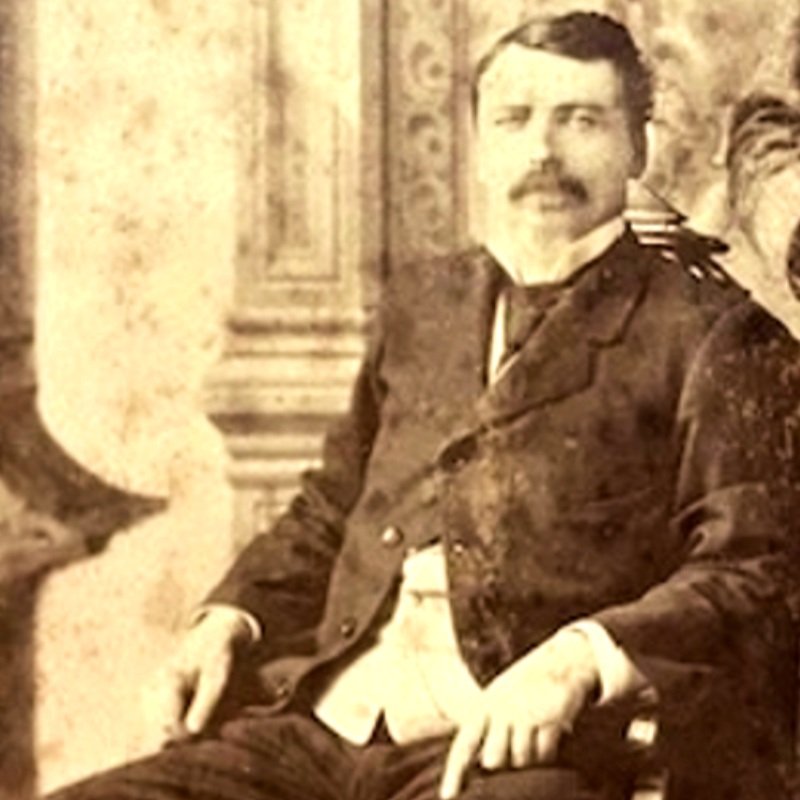
1844
In February 1863, Kelly emigrated to New York. He’d heard of the booming whiskey business in Nashville, Tennessee and decided to move there in 1864. His first job in Nashville was in the book and stationery business. Kelly also entered into the liquor trade, rectifying and selling his own brands.

1863 - 1864
In September 1866, Kelly stopped in Chattanooga. He began his own company, which included Kelly Tobacco Company, and founded Deep Springs Distillery. Kelly also partnered with Alabama grocer J.G. Webb. Their partnership dissolved in 1876.

1866
The Read House opens across the street from Kelly’s office building at 13-15 W Ninth Street. Kelly owned the bar, the billiards, the cigar shop, and one restaurant within the Read House. Read more about the lengthy history between JWK & The Read House.

1872
Kelly partnered with George W. Davenport near the end of 1876. They retained the tobacco and whiskey business, bought and sold real estate, and were prominent landlords for stores and private homes. G.W. Davenport retired from the firm in July 1890.

1876 - 1889
In 1900, Kelly brought in a new vice president, Carl White.
In December 1892, Kelly was named one of the One Hundred Men Who Have Done Much for Chattanooga. He was the only distiller on the list.

1890 - 1906
J.W. Kelly passed away on March 10, 1907. His wife, Elizabeth “Lizzie”, followed him months later, on November 7. The Kelly’s are interred together in Forest Hills Cemetery, Chattanooga, Section K, Lot 74.

1907
In 1909, the Tennessee legislature passed the Holladay Bill; which forbid the sale of liquor within four miles of any school in the state. The second law passed that day prohibited the manufacture of intoxicating beverages. The company also divided into 2 divisions: J.W. Kelly & Co. and Kelly Tobacco Company. Kelly Tobacco Company would be sold several times between 1914 and 1919.
In February 1911, Henry Kraver sold one-half interest in the Kentucky Peerless Distilling Plant to Carl White for $40,000 ($1.17 million in 2022).

1908 - 1916
J.W. Kelly & Co moved production to Henderson, KY. The company moved out of the building at 13-15 W. Ninth Street and sold non-alcoholic beverages in Tennessee.
When the 18th Amendment was ratified in 1919, J.W. Kelly & Co. ceased operations.

1917 - 1919
Prohibition forced the closure of the whiskey company who, by then, had only 1 member left on the board: Carl White. He retired and moved to California, where he passed away. Deep Spring Distillery was demolished in 1927.

1920 - 1927
Kelly Tobacco Company changed hands (and names) many times. In 1956, the company was purchased by the Witt Group.
In 1962, Kelly Cigar Company joined the Hav-A-Tampa Group. Kelly Tobacco Company closed its doors in 1963, three years shy of its 100th anniversary.

1928 - 1964
After the distillery was demolished in 1927, the only remaining building that Kelly built was the office at 13-15 W. Ninth Street. This building was the first steel structure built in Chattanooga. It changed hands - and addresses - several times, but the building was finally demolished in the early 1980’s.

1965 - 1980’s
In 2017, Keeper's Quest re-launched the J.W. Kelly & Co brand and revived Kelly's original whiskey recipe. Work still continues to preserve not only the legacy of Kelly's whiskey but also of the man himself.
You can read more about J.W. Kelly on his Wikipedia page; created and maintained by our Kelly Historian.
